


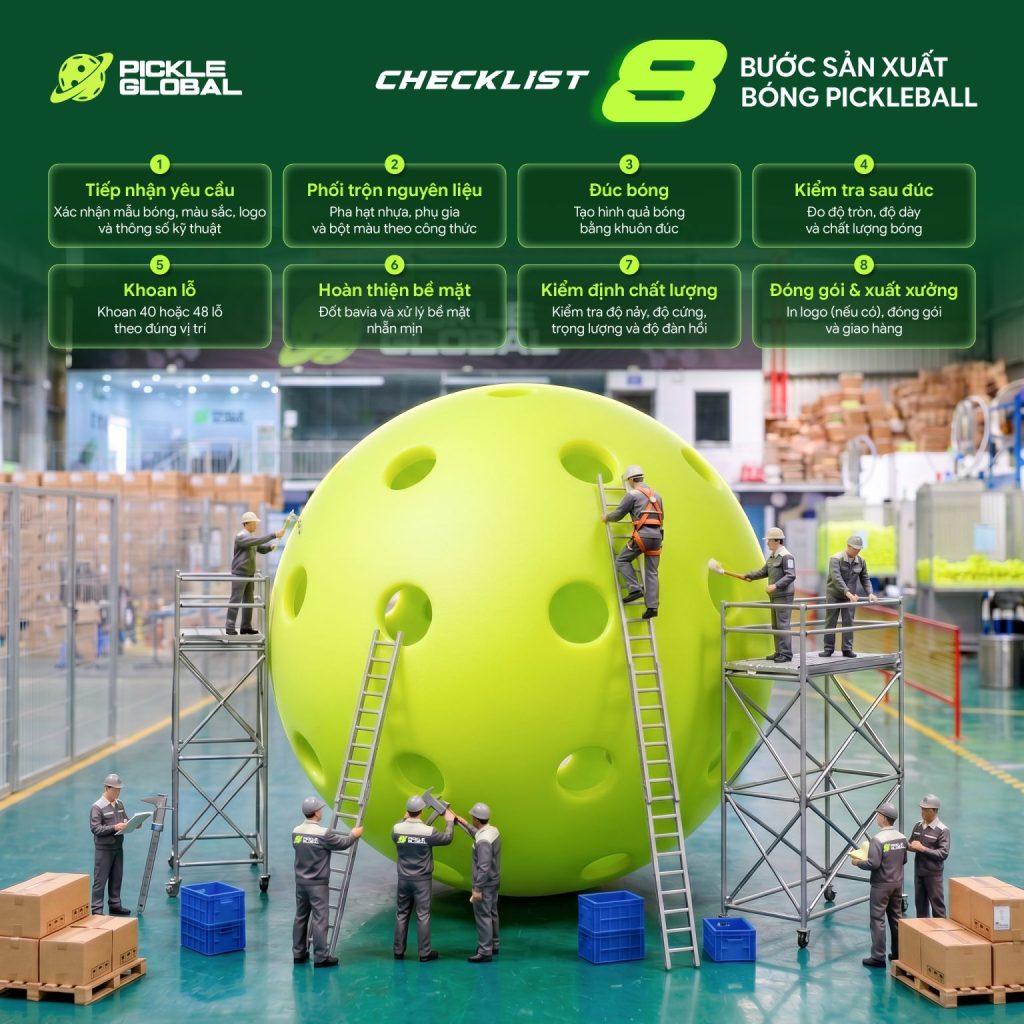
Producing a pickleball that achieves precise weight, bounce, durability, and aerodynamics requires an advanced technological manufacturing process. Join Pickle Global as we explore the detailed 8-step pickleball production process designed to meet the most stringent international tournament standards.
Overview of pickleball standards
A tournament-ready pickleball (according to USAPA – USA Pickleball standards) must satisfy the following fundamental specifications:
- Material: High-grade polymer plastic with high elasticity and strong impact resistance.
- Diameter: Ranging from 73mm to 75.5mm.
- Weight: Ranging from 22g to 26.5g.
- Number of Holes: Typically feature 26 to 40 precision-drilled holes (or a specialized 48-hole design) to ensure a stable flight trajectory.
- Bounce: Meets standards when dropped freely from a specified height.
To materialize these technical specifications into every single product, Pickle Global implements a closed-loop quality control system through 8 rigorous steps.
Detailed 8-step pickleball production checklist at Pickle Global
At Pickle Global’s manufacturing facility, mass production is carried out through the following 8 steps:
Step 1: Request reception and technical specification confirmation
Every production or OEM manufacturing order for pickleballs begins with a clear understanding of our clients’ and partners’ needs:
- Ball model confirmation: Confirming whether the balls are designed for Indoor or Outdoor play.
- Color and logo: Selecting vibrant color palettes such as fluorescent yellow, neon green, orange, etc., along with custom brand logo designs.
- Technical parameters: Agreeing on standards for hardness, wall thickness, target weight, and desired testing benchmarks.
Step 2: Raw material blending according to standard formulas
The quality of the plastic resin determines 80% of the ball’s durability and resilience:
- High-grade resin blending: Utilizing specialized polymers (such as premium TPE, PE, PP) capable of resisting cracking under heavy impact.
- Reinforcing additives: Adding UV inhibitors (preventing the ball from becoming brittle or fading under sunlight) and flexibility enhancers.
- Specialized pigment mixing: Pigment powders are mixed according to precise formulas to ensure uniform, bright colors across every production batch.
Step 3: Molding with modern tooling
This stage forms the core shape of the pickleball:
- The blended raw materials are fed into industrial molding machines (typically employing Rotomolding or Blow Molding technology).
- Under automatically controlled temperature and pressure, the molten plastic distributes evenly across the mold cavity, creating a complete shell with uniform wall thickness at every point.
Step 4: Post-molding preliminary inspection
Immediately after the balls leave the mold, Pickle Global’s engineering team conducts an initial evaluation right on the production line:
- Roundness measurement: Using specialized measuring equipment to verify that the ball is perfectly round without warping or deformation.
- Wall thickness measurement: Ensuring consistent thickness with no abnormal thin spots that could cause cracking.
- Shell quality assessment: Instantly discarding any shells with air bubbles, plastic defects, or thermal distortion.
Step 5: Precision hole drilling (40 or 48 holes)
The hole pattern directly influences the ball’s flight path and aerodynamics during play:
- Utilizing highly automated CNC drilling machines to guarantee absolute precision in hole spacing and placement.
- Depending on whether the ball is designed for Outdoor or Indoor use, it will be drilled with 40 holes or 48 holes with precisely programmed diameters.
- Accurate hole placement allows the ball to cut through the wind effectively, minimizing wobbling or trajectory drifts caused by outdoor winds.
Step 6: Surface finishing
After drilling, balls often retain flash/burrs (excess plastic ridges) around the hole edges and mold seam lines:
- Specialized deflashing / Thermal processing: Applying mild thermal techniques to smooth out excess plastic burrs without affecting the structural integrity of the ball.
- Surface treatment: Buffing and cleaning the entire surface to achieve high aesthetic appeal, a comfortable grip, and safe handling for players.
Step 7: Rigorous quality control (QC)
Before entering the packaging phase, each production lot must pass a comprehensive quality inspection:
- Bounce test: Free-fall drop testing to measure rebound height against official standards.
- Hardness and elasticity test: Measuring compressive strength to ensure the ball rapidly recovers its original shape after heavy impacts with paddles.
- Precision weight check: Ensuring weight variances fall strictly within the allowed threshold (±0.5g).
Step 8: Logo printing, packaging and dispatch
The final step in preparing the commercial product:
- Brand logo printing: Printing the Pickle Global logo or the client’s custom OEM logo using scratch-resistant, durable specialized inks.
- Standard packaging: Packaging in 3-pack, 6-pack, or 12-pack bags, or custom master cartons according to client specifications.
- Dispatch and delivery: Inventory count verification, applying security seals, and shipping to partners and customers nationwide.
Why choose Pickle Global for OEM / Custom pickleball manufacturing?
- Modern production line: High level of automation from molding and CNC drilling to final QC inspection.
- International quality standards: Fully compliant with strict parameters for bounce, durability, and aerodynamics.
- Custom OEM manufacturing: Supporting custom colors, branded logo printing for clubs, tournaments, and distributors.
- Optimized cost: Direct factory production without intermediaries, providing the most competitive prices on the market.
The 8-step pickleball manufacturing process at Pickle Global is a testament to our meticulousness, professionalism, and unwavering commitment to quality for the pickleball community. The synergy between modern technology and strict quality control ensures that every ball leaving our facility delivers the ultimate playing experience.
Do You Provide Quality Control and Export Documentation?
Yes. Pickle Global performs quality control throughout production and conducts 100% output QC checks before shipment.
Depending on the order and destination market, the company can also provide the necessary documentation to support product compliance and import/export procedures.
Quality control covers factors such as:
Ball wall uniformity
Hardness
Bounce
Weight
Durability
Finished product inspection
Yes. Pickle Global can support B2B pickleball orders for distributors, clubs, tournaments, and other business customers in the Philippines.
Shipping arrangements, estimated delivery times, and transportation costs are determined according to the order quantity, destination, and commercial terms agreed for each project.
Yes. Pickle Global supports international B2B orders and can arrange delivery to customers in Malaysia.
Shipping costs and delivery terms depend on the order quantity, destination, shipping method, and agreed commercial terms. Buyers should provide the delivery location when requesting a quotation so the team can recommend a suitable shipping solution.
Payment terms depend on the order value, customization requirements, production specifications, and agreed commercial conditions.
The applicable payment schedule and commercial terms will be clearly stated in the quotation or order confirmation before production begins.
Yes. Pickle Global supports customized packaging for OEM/ODM and private-label pickleball projects.
Customers can discuss requirements for ball colors, logos, boxes, packaging formats, packing specifications, and other branding elements before sample production.
For customized OEM/ODM projects, sample production is typically carried out within approximately 5–10 days after the product specifications, colors, logo, and packaging requirements have been confirmed.
The exact timeline may vary depending on the level of customization.
Yes. Pickle Global supports sample testing before mass production so buyers can evaluate ball bounce, durability, hardness, appearance, logo quality, and packaging before confirming a bulk order.
Sample support and related shipping arrangements will be confirmed based on each project.
To provide an accurate quotation, please share your requirements, including product specifications, quantity, logo artwork (if applicable), color preferences, packaging requirements, delivery destination, and any relevant technical drawings or reference files. The more detailed the information, the more accurate and competitive the quotation will be.
Yes. We have a quality control process in place to ensure products meet agreed specifications before shipment. In the event of verified manufacturing defects, we will review the case and provide appropriate support, which may include replacement, compensation, or other remedies as agreed in the sales contract and warranty policy. Please contact us with relevant details and supporting evidence for evaluation.
The sample lead time depends on the level of customization and production requirements. For standard samples, production typically takes a few working days. For customized OEM/ODM samples, the lead time may vary depending on logo, color, packaging, and tooling requirements. Please send us your specifications for an accurate timeline estimate.
Yes. Pickle Global provides custom branding options for distributors, brands, clubs, tournaments, and corporate projects.
Available customization options include:
UV logo printing
Molded or embossed logos
Custom ball colors
Custom hardness
Custom packaging
Our team can recommend the most suitable branding method based on the intended use and order requirements.
Yes. We provide both OEM and ODM services, including custom logos, colors, packaging, and product specifications according to customer requirements. Please send us your RFQ, and our team will advise on the most suitable solution for your project.
The minimum order quantity (MOQ) depends on the ball type, logo/color/packaging requirements, and production specifications. For standard orders or custom OEM orders, please send us your RFQ so our team can recommend the most cost-effective order quantity based on your requirements.